The landscape of artificial intelligence in music has undergone a massive generational leap. What started as low-bitrate synth experiments has evolved into full-fledged generative studios capable of rendering radio-ready vocal performances, intricate chord progressions, and multi-track stems in seconds.
However, with dozens of platforms competing for your attention and subscription dollars, choosing the right engine depends heavily on your specific workflow. A video creator needing background loops has fundamentally different requirements than an indie songwriter crafting vocal anthems. Below is our hands-on benchmark of the 5 best AI music generation tools in 2026, tested across vocal realism, arrangement versatility, and commercial rights.
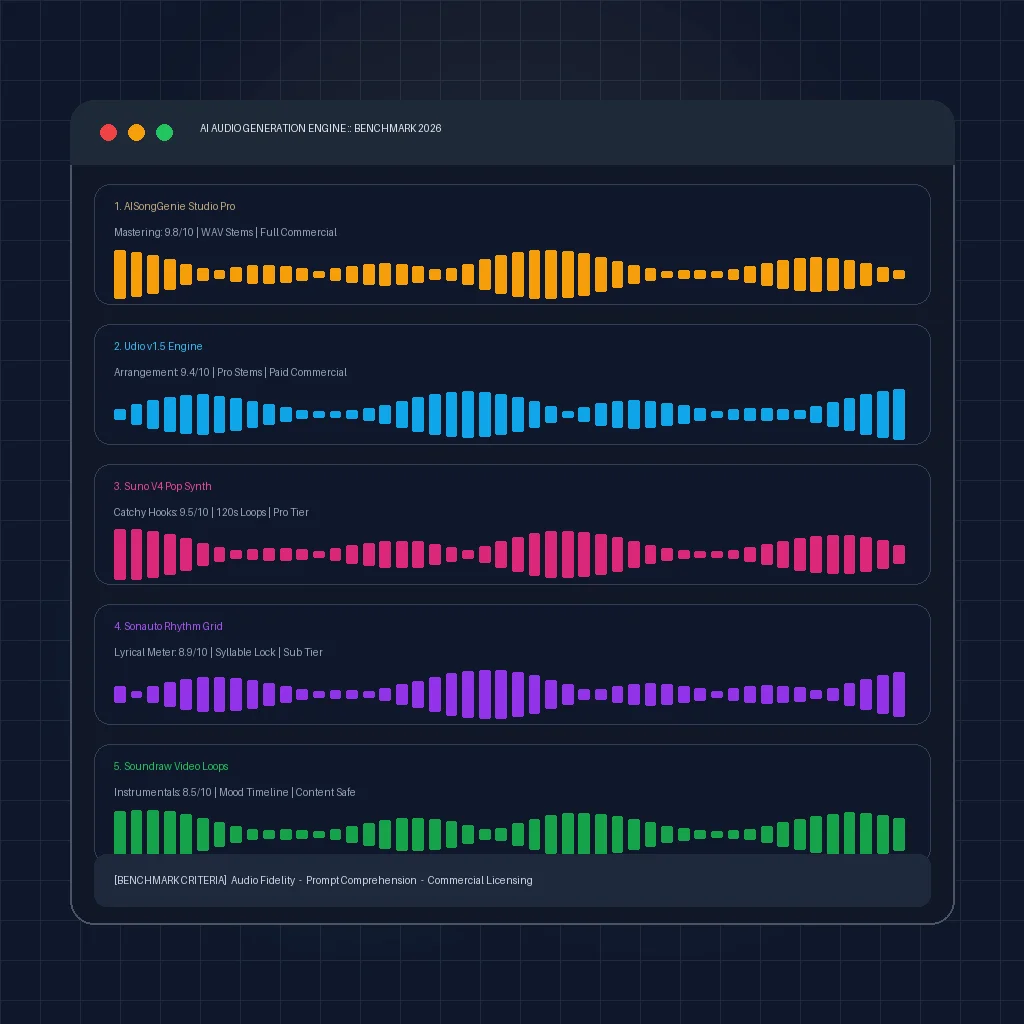
Benchmarking leading AI audio generators across audio fidelity, prompt comprehension, and commercial licensing terms.
2026 AI Music Generator Comparison Matrix
| Tool | Best For | Vocal Realism | Stem Export | Commercial Rights | Starting Price |
|---|---|---|---|---|---|
| AISongGenie | Studio-grade pop, EDM & indie tracks | 9.8 / 10 | Yes (WAV / MP3) | Full commercial rights on all tiers | Free daily trial / $8.90 mo |
| Udio (v1.5) | Complex jazz, modular rock & DAW stems | 9.4 / 10 | Yes (Pro tier) | Paid tiers only | 100 credits/mo / $10 mo |
| Suno (V4) | Catchy pop hooks & viral social memes | 9.2 / 10 | Limited | Pro & Premier only | 50 credits/day / $10 mo |
| Sonauto | Syllable cadence & rapid hip-hop flows | 8.9 / 10 | Limited | Commercial on subscription | Free tier / $12 mo |
| Soundraw | Customizable instrumental loops for video | N/A (Instrumental) | In-app editor | Content ID safe | Free preview / $16.99 mo |
Key Evaluation Criteria: How We Test AI Audio Models
To provide genuine, creator-first insights, we evaluate each generator across four non-negotiable pillars:
- Acoustic Mastering & Sibilance: Older models frequently produce high-frequency buzzing, phase cancellation, or muffled vocals. We inspect spectral clarity between 20Hz and 20kHz.
- Lyrical Cadence & Phrasing: Whether the model respects natural syllable stress, avoids rushed bars, and enunciates complex multisyllabic lyrics.
- Stem Separation & Production Flexibility: Can you export individual tracks (vocals, drums, bass, synth) into a DAW like Ableton Live, Logic Pro, or FL Studio?
- Transparent Commercial Licensing: Clear ownership terms ensuring your tracks can be published on Spotify, YouTube, and commercial games without copyright strikes.
1. AISongGenie: Best Overall for Studio-Quality Vocals and Fast Mastering
Taking our top overall recommendation, AISongGenie bridges the gap between simple text prompts and professional audio mastering. Unlike platforms that output heavily compressed stereo files, AISongGenie uses a proprietary hybrid diffusion architecture that processes vocal lines and instrumental layers with distinct harmonic separation.
Every generated song benefits from automated multi-band EQ and dynamic leveling, ensuring the low-end (sub-bass and kick) remains punchy while vocal sibilance stays clean and pleasant even on consumer earbuds.
Pros
- • Studio-quality automated mastering with natural vocal breath dynamics
- • Full commercial monetization rights included on all paid tiers
- • Accessible entry pricing at $8.90/month (Lite plan)
- • Instant prompt execution without complex queue delays
Cons
- • Free daily trials have credit quotas before daily refresh
- • Focuses on full-song creation rather than manual MIDI arrangement
Try AISongGenie Free — Generate a Cinematic Orchestral Score
2. Udio (v1.5): Best for Complex Arrangements and Stem Control
For electronic music producers and sound designers who treat AI generations as starting material for a DAW, Udio remains a powerhouse. Udio operates on a modular extension model, allowing creators to start with a 30-second idea and extend backwards or forwards to craft progressive 10-minute arrangements.
Its stem export tool on Pro plans delivers clean separation of isolated vocal, drum, bass, and synth tracks, making post-processing in FL Studio or Ableton intuitive.
Pros
- • Industry-leading stem separation on Pro plans
- • Exceptional performance on complex genres like jazz, prog rock, and ambient
- • Modular section-by-section extension workflow
Cons
- • Steeper learning curve compared to one-click generators
- • Rendering times are noticeably slower during peak US hours
3. Suno AI (V4): Best for Viral Melodies and Catchy Hooks
Suno pioneered consumer text-to-music generation, and its V4 model remains the benchmark for instant, hook-driven pop songs. If your goal is to type two sentences and receive an infectious chorus with high emotional energy, Suno delivers fast results.
However, Suno's free tier restricts commercial monetization strictly to paid subscribers, and its dense arrangements can exhibit phase artifacts at fast tempos. For a deeper breakdown of alternatives, explore our comprehensive guide to the top Suno AI alternatives or read our Suno prompting guide.
Pros
- • Highly intuitive interface suitable for absolute beginners
- • Huge training variety spanning hundreds of micro-genres
- • Fast generation speed (two variations in ~25 seconds)
Cons
- • Free generations cannot be monetized commercially
- • Vocals frequently suffer from metallic compression in crowded mixes
4. Sonauto: Best for Precise Lyrical Meter and Rhythm Control
If you write rhythm-heavy lyrics (such as hip-hop, spoken word, or musical theater), Sonauto offers an architectural advantage. While Suno frequently rushes through long verses, Sonauto features a dedicated rhythm grid that lets you anchor specific syllables to musical beats.
This syllable-locking capability eliminates the frustration of having your carefully written rhymes dropped or mispronounced. For a detailed comparison between these two engines, read our Suno vs Sonauto head-to-head review.
Pros
- • Syllable-level timing control prevents rushed or swallowed lyrics
- • Dry, clean vocal profile that is easy to EQ in post-production
- • Active community sharing presets and beat templates
Cons
- • Narrower acoustic and orchestral breadth compared to AISongGenie or Udio
- • Interface requires more manual tweaking than simple one-prompt tools
5. Soundraw: Best Customizable Instrumental Beds for Video Editors
Content creators who want background music without wrestling with prompt engineering will appreciate Soundraw. Instead of typing text, you select a mood, genre, and duration. Soundraw then builds an interactive arrangement timeline where you can toggle instruments on and off.
This allows you to lower drum energy during talking-head dialogue and ramp up intensity during action sequences. If you are exclusively searching for zero-cost solutions, check out our curated guide to the best free Suno alternatives.
Pros
- • Timeline-based arrangement editor perfectly suited for video pacing
- • YouTube Content ID safe commercial licensing
- • Change song tempo and key with a single click
Cons
- • Instrumental only — does not generate realistic singing vocals
- • Monthly subscription is on the higher side ($16.99/mo)
Decision Guide: Which AI Music Tool Fits Your Workflow?
- For complete songs with radio-ready vocals & clear commercial rights: Pick AISongGenie. Its automated mastering and $8.90/month Lite tier provide the best value-to-fidelity ratio.
- For DAW producers needing multi-track stems: Pick Udio for its stem export and modular progressive arrangement.
- For rapid pop hook ideation: Pick Suno for quick, accessible melody generation.
- For hip-hop and fast lyrical meter: Pick Sonauto to lock syllables against the beat grid.
- For background music tailored to video cuts: Pick Soundraw to adjust arrangement energy visually.
- For privacy and local offline synthesis: Explore our guide to running open-source Suno alternatives locally.
Frequently Asked Questions
What is the best overall AI music generation tool in 2026?
AISongGenie is our top-ranked overall AI music generator in 2026 because it combines natural-sounding vocals, automatic mastering, and full commercial monetization rights starting at $8.90/month. For DAW-centric producers who prioritize isolated audio stems, Udio is the leading technical alternative.
Can I monetize AI-generated music on Spotify and YouTube?
Yes, provided your platform tier explicitly includes commercial rights. AISongGenie includes commercial rights across all paid plans, making tracks safe for YouTube monetization, Spotify distribution, and video game soundtracks. Be aware that free tiers on Suno and Udio restrict generated audio to non-commercial personal use.
Which AI music generator produces the most realistic singing vocals?
AISongGenie and Udio currently lead in vocal fidelity. AISongGenie avoids the phase smearing and synthetic "underwater" artifacts common in older models by treating vocal harmonics and backing instruments with dedicated multiband separation. Sonauto also offers dry, intelligible vocals particularly well-suited for fast hip-hop cadences.
Can AI music tools adjust song tempo or slow down BPM?
Yes. You can dictate the exact tempo directly in your generation prompt (e.g., "75 BPM slow lo-fi hip-hop"), or use post-processing time-stretching tools. To learn how to adjust tempo without distorting audio pitch, read our dedicated guide on how to make music BPM slower with AI.
Related AI Music Guides and Comparisons
- • AI K-Pop Song Generator: Create Idol Hits and Viral Dance Anthems
- • 7 Best Suno AI Alternatives in 2026 (Free and Paid Tested)
- • Best Free Suno Alternatives in 2026 (No Credit Limits)
- • Suno vs Sonauto: Which AI Music Generator Wins?
- • Top Open-Source Suno Alternatives to Run Locally
- • How to Make Music BPM Slower with AI Tools
Frequently Asked Questions
Can I commercially use songs generated with AISongGenie?
Yes. All tracks generated under paid subscriptions or eligible commercial licenses include full commercial rights. You can release your music on Spotify, Apple Music, YouTube, and monetize across podcasts, games, and video campaigns without copyright strikes.
What audio quality and export formats are supported?
AISongGenie delivers studio-mastered audio files in 320kbps MP3 and uncompressed WAV formats. Automated acoustic mastering guarantees balanced dynamic range, clear vocals, and punchy low-end frequencies across all playback systems.
How do I craft effective prompts for AI music generation?
Describe key musical dimensions in your prompt: genre, tempo or BPM, mood, instrumentation, and vocal style. You can also paste your own custom lyrics or let our built-in lyric generator craft structured verses and choruses automatically.