Relying exclusively on commercial cloud platforms like Suno or Udio carries undeniable risks: recurring monthly subscriptions, sudden pricing or terms-of-service shifts, strict daily token quotas, and privacy concerns regarding proprietary prompts and stems. For software developers, AI researchers, and technical music producers, self-hosting an open-source Suno alternative is the ultimate solution.
By running open weights on your local machine or private cloud instance, you gain total data sovereignty: zero generation limits, offline capability, custom fine-tuning on your own audio stems, and guaranteed privacy. Below is our comprehensive benchmark of the top open-source text-to-music models in 2026.
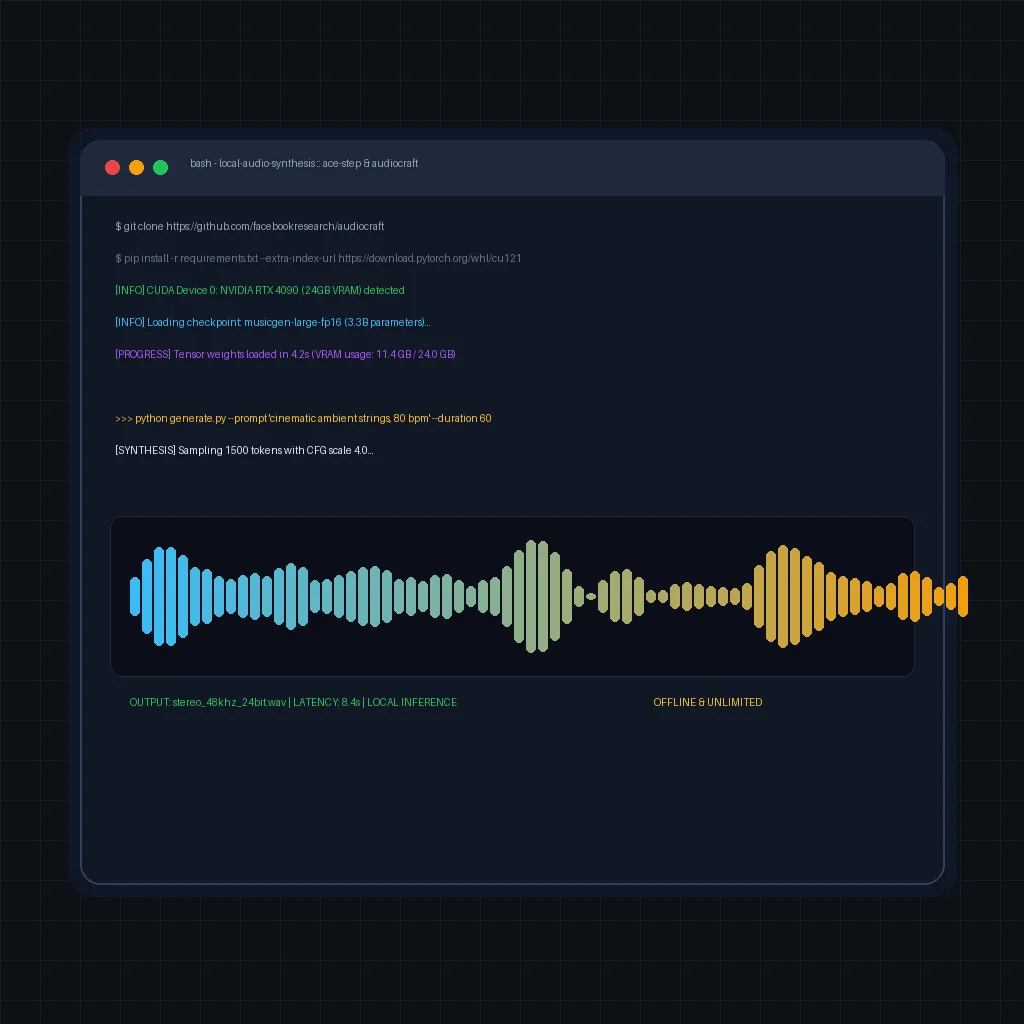
Testing local inference latency, VRAM footprint, and audio sample quality across open-weights models.
Hardware and Architecture Comparison: Open Models
| Model / Framework | Developer | Min VRAM | Audio Output | Open Weights License | Best For |
|---|---|---|---|---|---|
| AudioCraft (MusicGen) | Meta AI Research | 8GB (Medium) / 16GB (Large) | 32kHz mono/stereo | CC-BY-NC 4.0 / MIT (Tooling) | Rich instrumental arrangements & score sketching |
| Stable Audio Open | Stability AI | 12GB VRAM | 44.1kHz stereo (up to 47s) | Community License | Sound design, drum loops & high-fidelity beds |
| Bark | Suno (Legacy OSS) | 4GB–8GB VRAM | 24kHz voice/audio | MIT License (Fully Open) | Expressive speech, laughter & raw singing drafts |
| ACE-Step Audio | Open-Source Community | 16GB VRAM (FP16) | 48kHz stereo | Apache 2.0 | Step-wise diffusion & multitrack experimentation |
1. Meta AudioCraft (MusicGen): The Most Versatile Foundation
Released by Meta AI, MusicGen remains the gold standard for open-source generative music. Built on the AudioCraft library, MusicGen comes in three primary parameter sizes: Small (300M), Medium (1.5B), and Large (3.3B), alongside specialized "Melody" checkpoints that can harmonize existing humming or MIDI files.
Why It Excels
- Harmonic Coherence: Unlike older toy models, MusicGen Large understands chord progressions, syncopated rhythms, and instrumentation tags cleanly.
- Broad Community Tooling: You can run it effortlessly via popular WebUIs such as Pinokio, ComfyUI nodes, or standard Hugging Face Transformers pipelines.
- Fine-Tuning Capability: Producers with custom sample libraries can use LoRA (Low-Rank Adaptation) to train MusicGen on their proprietary sonic palettes.
2. Stability AI Stable Audio Open: Pristine Stereo Fidelity
While Meta’s MusicGen is phenomenal for arrangement, Stability AI’s Stable Audio Open is engineered for acoustic clarity. Operating on a latent diffusion architecture with continuous time autoencoders, it outputs native 44.1kHz stereo audio up to 47 seconds in length.
It is particularly dominant at producing transient-heavy percussion, cinematic impact soundscapes, and lush synthesizer sweeps. The primary limitation is that it focuses purely on instruments and sound effects—it does not support full singing lyrics.
3. Bark by Suno: The Open-Source Origin Story
Before launching their proprietary closed-source web service, the team behind Suno gained widespread acclaim by open-sourcing Bark under the permissive MIT license. Bark is a transformer-based text-to-audio model designed for speech, but clever prompting (using musical notes like ♪ In the dark of night ♪) triggers surprisingly expressive, if lofi, human singing.
Bark is lightweight, runs comfortably on consumer GPUs with as little as 6GB of VRAM, and can be integrated into commercial Python applications with zero licensing fees.
Hardware Reality Check: What Do You Need to Run Locally?
Before diving into terminal installations, ensure your local rig meets these baseline specifications:
- GPU (NVIDIA Required): Local audio diffusion relies heavily on CUDA and FlashAttention. A card with at least 12GB to 16GB of VRAM (such as an RTX 4070 Ti, RTX 3090, or RTX 4090) is strongly recommended for FP16 inference without out-of-memory crashes.
- System RAM: 32GB of DDR4/DDR5 system memory is required to load large transformer weights into VRAM smoothly.
- Disk Storage: Expect each model checkpoint to consume between 3GB and 14GB of SSD storage.
The Dilemma: Local Flexibility vs Production Speed
Running local open models provides unmatched privacy and freedom, but it demands technical friction: managing Python environments, compiling PyTorch with CUDA 12, dealing with driver updates, and waiting 45 seconds to render a single 30-second audio clip.
If you need the full-frequency mastering and singing fidelity of state-of-the-art models without turning your workstation into a space heater, AISongGenie delivers cloud-accelerated generation with zero local setup. Try our orchestral soundtrack preset below:
Try AISongGenie Free — Generate a Cinematic Orchestral Score
Quickstart: Generating Your First Track with AudioCraft
To run MusicGen locally in under five minutes, execute the following commands in your Python 3.10+ terminal:
pip install torch torchvision torchaudio --index-url https://download.pytorch.org/whl/cu121
pip install audiocraft

from audiocraft.models import MusicGen
model = MusicGen.get_pretrained('facebook/musicgen-medium')
model.set_generation_params(duration=30)
wav = model.generate(['driving synthwave track with 80s drums, 120 bpm'])
Frequently Asked Questions
Is there an open-source alternative to Suno AI?
Yes. The most capable open-source alternatives to Suno in 2026 are Meta AudioCraft (MusicGen), Stable Audio Open by Stability AI, and Bark (originally released by Suno's own team under the MIT license). All three are available on Hugging Face and can be run locally using standard Python environments. MusicGen Large is the closest match to Suno's full-song generation capability.
Can I run Suno locally on my own computer?
Suno's production model is proprietary and closed-source—you cannot run it locally. However, Bark (the open-source predecessor released by Suno's founders before commercializing) is available under the MIT license and can generate expressive singing audio locally on a GPU with as little as 4GB–8GB of VRAM. For full instrumental music generation locally, Meta's MusicGen is a stronger choice.
What GPU do I need to run MusicGen locally?
For comfortable real-time inference with MusicGen Medium (1.5B parameters), a GPU with at least 8GB of VRAM is required—an NVIDIA RTX 3070, RTX 4060 Ti, or equivalent. The Large model (3.3B parameters) runs reliably at FP16 precision on cards with 16GB of VRAM (RTX 3090, RTX 4080, RTX 4090). AMD GPUs are technically supported through ROCm but have significantly less community tooling and higher setup friction.
Is Meta's MusicGen free for commercial use?
It depends on the model variant. The MusicGen model weights are released under a CC-BY-NC 4.0 license, which means non-commercial use only for the model itself. The AudioCraft Python tooling and training code are MIT-licensed. If you require a fully commercially-permissive open model, ACE-Step (Apache 2.0) is the safest option. Always consult the specific license file of each Hugging Face checkpoint before commercial deployment.
Explore Related AI Music Guides
Frequently Asked Questions
Can I commercially use songs generated with AISongGenie?
Yes. All tracks generated under paid subscriptions or eligible commercial licenses include full commercial rights. You can release your music on Spotify, Apple Music, YouTube, and monetize across podcasts, games, and video campaigns without copyright strikes.
What audio quality and export formats are supported?
AISongGenie delivers studio-mastered audio files in 320kbps MP3 and uncompressed WAV formats. Automated acoustic mastering guarantees balanced dynamic range, clear vocals, and punchy low-end frequencies across all playback systems.
How do I craft effective prompts for AI music generation?
Describe key musical dimensions in your prompt: genre, tempo or BPM, mood, instrumentation, and vocal style. You can also paste your own custom lyrics or let our built-in lyric generator craft structured verses and choruses automatically.