Generating a breathtaking musical idea with an AI audio generator takes seconds, but bringing that melody to life on a real grand piano, acoustic guitar, or orchestral ensemble requires musical notation. For centuries, transcribing complex polyphonic chords and rapid violin runs by ear demanded dozens of hours of painstaking manual dictation.
Today, neural audio recognition and deep learning pitch detection make automated audio-to-score transcription accessible to every musician. An AI sheet music generator can analyze raw audio files, detect fundamental frequencies across polyphonic layers, quantize erratic rhythms, and export clean MusicXML, MIDI, and PDF scores. Below is our field-tested guide to the top AI transcription engines and how to turn AI-generated songs into playable sheet music.
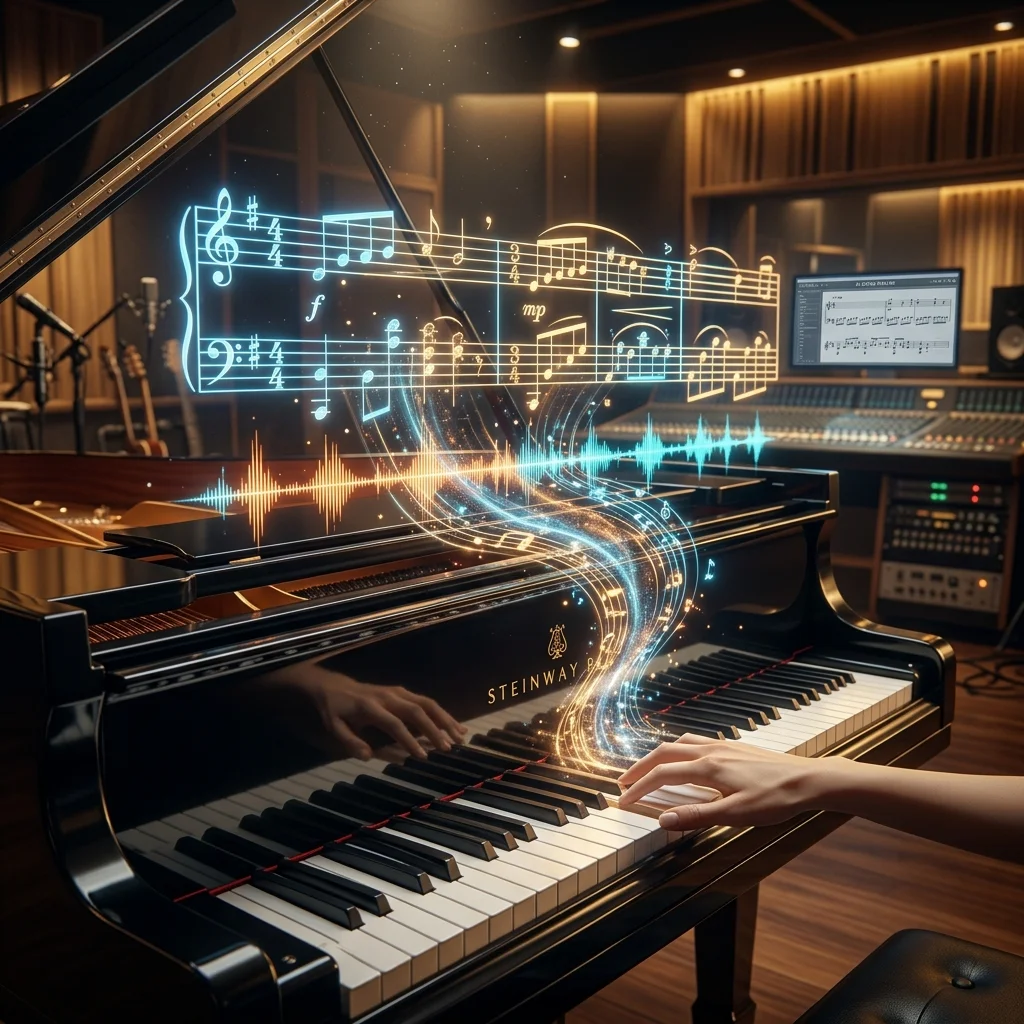
Comparing polyphonic pitch detection, note quantization accuracy, and MusicXML export across top transcription platforms.
Quick Comparison Matrix: Leading AI Sheet Music Generators
| Tool | Best For | Polyphonic Accuracy | Output Formats | Guitar Tab Support | Pricing |
|---|---|---|---|---|---|
| AnthemScore | Complex piano solos and chamber music | 9.5 / 10 | MusicXML, MIDI, PDF | No | $36–$45 one-time purchase |
| Klangio (Piano2Notes) | Browser-based piano and guitar transcription | 9.2 / 10 | PDF, MIDI, MusicXML | Yes (Guitar2Tabs) | Free demo / $9.99 mo |
| ScoreCloud | Singing voice and monophonic lead lines | 8.7 / 10 | PDF, MIDI, Audio | Limited | Free tier / $4.99 mo |
| AISongGenie Pipeline | Generating transcription-ready acoustic stems | 9.8 / 10 (Audio Source) | WAV and 320kbps MP3 | Compatible with all tab software | Free daily credits / $8.90 mo |
How AI Audio-to-Sheet Transcription Works
Transcribing audio into musical notation is mathematically far more complex than simple voice-to-text recognition. A modern neural transcription engine executes four distinct processing stages:
- Time-Frequency Decomposition (CQT): The raw audio waveform is converted into a Constant-Q Transform spectrogram, which provides logarithmic frequency spacing matching human musical octaves.
- Polyphonic Pitch and Onset Detection: A convolutional neural network scans the spectrogram to identify note attacks (the exact millisecond a piano hammer hits the string) and fundamental frequencies ($f_0$), filtering out secondary harmonic overtones.
- Duration and Polyphony Tracking: The model tracks how long each individual note rings out, resolving complex chords where different voices hold notes of unequal lengths.
- Rhythmic Quantization: The detected timings are snapped to musical bar lines (e.g., quarter notes, dotted eighth notes, triplets) based on time signature and detected BPM.
1. AnthemScore: The Gold Standard for Polyphonic Piano Transcription
If you need to transcribe multi-voice piano pieces, AnthemScore provides the highest transcription precision on the market. Unlike lightweight web apps, AnthemScore runs locally on your PC or Mac, utilizing GPU acceleration to calculate high-resolution spectrograms.
Pros and Cons
AnthemScore Strengths
- • Visual spectrogram editor allows manual clicking to add or remove notes.
- • Accurate tempo detection with automated dynamic time signatures.
- • One-time purchase license with lifetime updates, avoiding monthly subscriptions.
Limitations
- • Requires desktop installation and a capable multi-core CPU.
- • Struggles if the source audio contains heavy percussion, drums, or distorted bass.
2. Klangio Suite: Best for Guitar Tabs and Mobile Convenience
The Klangio ecosystem offers dedicated specialized models: Piano2Notes for keyboard music, Guitar2Tabs for acoustic and electric guitars, Sing2Notes for vocal melodies, and Rhythm2Score for drums. The Guitar2Tabs tool is particularly valuable because it does not just identify pitch—it intelligently calculates which fret and string combination is most ergonomically playable on a guitar neck.
3. The AISongGenie to Sheet Music Workflow
The secret to getting flawless sheet music from an AI generator is the purity of the source audio. If you feed an AI transcription tool a dense pop song with vocal delays, synth pads, and 808 drums, the transcription will be flooded with phantom notes.
By using AISongGenie to generate an isolated, pristine acoustic piano or solo cello piece with zero background noise, you provide the transcription model with clean, unambiguous harmonic transients. Explore our dedicated AI instrumental music maker guide for generating clean acoustic melodies.
Want to generate a transcription-ready piano sonata right now? Try our acoustic concert preset:
Try AISongGenie Free — Generate a Piano Sonata for Transcription
Step-by-Step: How to Turn Any Song into Sheet Music
- Generate an Isolated Solo Track: Prompt AISongGenie with phrases like
[Solo acoustic grand piano] [Clean dynamic attack] [No drums, no vocals, no reverb wash]. - Export Uncompressed WAV: Always use 16-bit or 24-bit uncompressed WAV files. Compressed MP3s discard high-frequency transient information that transcription algorithms depend on.
- Import into AnthemScore or Klangio: Let the software analyze note onsets and adjust the sensitivity slider to filter out room acoustic reflections.
- Export MusicXML into MuseScore or Sibelius: Exporting MusicXML allows you to open the score in free notation software like MuseScore to fine-tune phrasing marks, dynamic symbols, and fingering notations.
Frequently Asked Questions
Can an AI sheet music generator transcribe songs with drums and vocals?
While some engines will attempt it, the results are usually cluttered with spurious ghost notes caused by cymbal frequencies and vocal vibrato. For optimal accuracy, separate the vocals and drums using a stem splitter first, or transcribe purely solo instrumental recordings.
Can AI generate guitar tabs with fret numbers?
Yes. Specialized tools like Klangio Guitar2Tabs use machine learning trained specifically on guitar neck ergonomics to determine whether a middle C should be played on the B string (1st fret) or G string (5th fret), providing accurate tablature numbers.
What file format should I export from an AI sheet music generator?
MusicXML is the universal standard. Unlike a static PDF, a MusicXML file preserves playback velocity, tempo markings, and note pitch, allowing you to edit the score in notation software such as MuseScore, Sibelius, Dorico, or Finale.
Related Notation and Production Guides
Frequently Asked Questions
Can I commercially use songs generated with AISongGenie?
Yes. All tracks generated under paid subscriptions or eligible commercial licenses include full commercial rights. You can release your music on Spotify, Apple Music, YouTube, and monetize across podcasts, games, and video campaigns without copyright strikes.
What audio quality and export formats are supported?
AISongGenie delivers studio-mastered audio files in 320kbps MP3 and uncompressed WAV formats. Automated acoustic mastering guarantees balanced dynamic range, clear vocals, and punchy low-end frequencies across all playback systems.
How do I craft effective prompts for AI music generation?
Describe key musical dimensions in your prompt: genre, tempo or BPM, mood, instrumentation, and vocal style. You can also paste your own custom lyrics or let our built-in lyric generator craft structured verses and choruses automatically.